
Two Hoots (4+) 9781035019717 (Hardback)
Please consult our group leader information for guidance on taking part in shadowing.
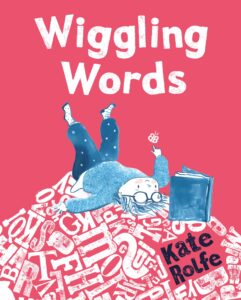
The child at the centre of the story is endeavouring to read, but the letters continually jump and jumble. Words and letters are used as building blocks for the illustrations creating playful and imaginative layers. The colour palette is striking throughout and there’s plenty of movement to lend both energy and pace to the story.
Themes:
Please complete the form below and click 'submit' to send your review to your Shadowing Group Leader.
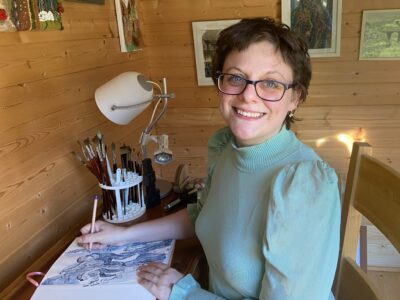
Kate Rolfe is an author and illustrator living in Suffolk who studied Animation at Plymouth College of Art, BA (Hons) Film Production at Northern Film School and graduated with an MA in Children’s Book Illustration at Cambridge School of Art in 2022. Aside from writing and illustrating her own ideas, she works in textile designs, teaches illustration, runs drawing sessions online and works in an independent bookshop. Kate has won many awards including New Talent in Children’s Publishing at the World Illustration Awards 2022 and Student Illustrator of the Year 2022 at the V&A Illustration Awards. Her first book, Wolf and Bear, also published by Two Hoots, was shortlisted for the Waterstones Children’s Book of the Year prize. Wiggling Words is the winner of the World Illustration Awards (children’s category) in 2024.
I think it is good but I also think that there could be a few more words because even for little ones it is a bit short.
Prabhsharan
LomondSchoolHelensburgh
I really liked the use of letter forms and a limited colour palette.
Ms Hill
Kings Langley School Library
I think that this is good for people with dyslexia, it can help them understand their own struggle and help others too as well. If you struggle with dyslexia, the words are quite big as well so that can help to read. I think this book is a good book overall as it could help them to start with reading and start their own reading journey. The illustrations were very nice becasue the letters are really creative - it really helped to understand the message of the story.
Jack
Brockhill Book Club
I think that the book is a good representation of people who struggle reading because it shows that even when you have dyslexia you can make your own ways of reading. The illustrations are very clever - how it makes different animals and shapes out of letters of the words. I liked that at the end of the book that she wrote a letter to raise awareness of dyslexia and that even becasue of her own dyslexia, she makes her own way of reading.
Eva
Brockhill Book Club
I think the book is definitely good for people who struggle with dyslexia, especially if they are young as it explains dyslexia in an easy way to understand. It can show what dyslexia is like for those who have it. I think that it is well made. I really liked that the author had a section at the back of the book where she explained what dyslexia was like for her, it helped me understand the reading difficulty more. I think it was explained very well.
Bea
Brockhill Book Club
It was a quick read as there weren't too many words involved. It made me realise how many things you can make out of letters. I thought it was pretty good! The design wasn't as detailed as I normally would read, but it was quite fun to read. I think the meaning was that anyone can imagine and make whatever they want out of anything. I thought the dyslexia theme was good as I haven't seen this topic often in books.
Oscar
Brockhill Book Club
It was a good book - the pictures looked cool. I liked the way the letters made the pictures and that the pictures linked with the words quite well. My favourite pages were when the animals were made out of letters.
Tom
Brockhill Book Club
It is a very good book. It is good for people with dyslexia as it has more pictures than words. I like that the pictures linked up with the letters that they were writing about. The Illustrations were really cool - I liked the page where they made a castle out of letters!
Annabella
Brockhill Book Club
I loved spotting the letters that made the pictures and the patterns the letters made. The book has a lovely gentle pace and I loved the main character, everything was so beautifully drawn. The story kept me turning the pages. I can't wait until our paper copy arrives at our school library so we can read it to each other.
Jo
Ocklynge Readers
I think it is a really good book. It is about a kid who is struggling to read the words on the page and he just goes through it bit by bit. UIsing his imagination to create his own world through the words. It's basically based on a kid who is trying to read a book, but he can't and gets frustated, then finds his own way to read the book. I think it is to highlight that even if your brain is different, you can still do things that other people can but in your own way. The illustrations are really good - they were pictures made of words and letters which was very well crafted. Overall, I really liked the book!
Eva
Brockhill Book Club
I liked that the book talked about someone's struggle with dyslexia and how they struggle with reading. I liked the illustration of the words bounce along the page and in lots of different places. I also liked the bit at the end and what actually happened to her when she was reading. I really like how the red colours of the illustrations pop off the page. I think the illustrations link in really well with the story and really represents what is going on when it comes to dyslexia and reading. 4/5 - I liked the book
Chayse
Brockhill Book Club