
carnegies.co.uk | #Carnegies2026 | @CarnegieMedals
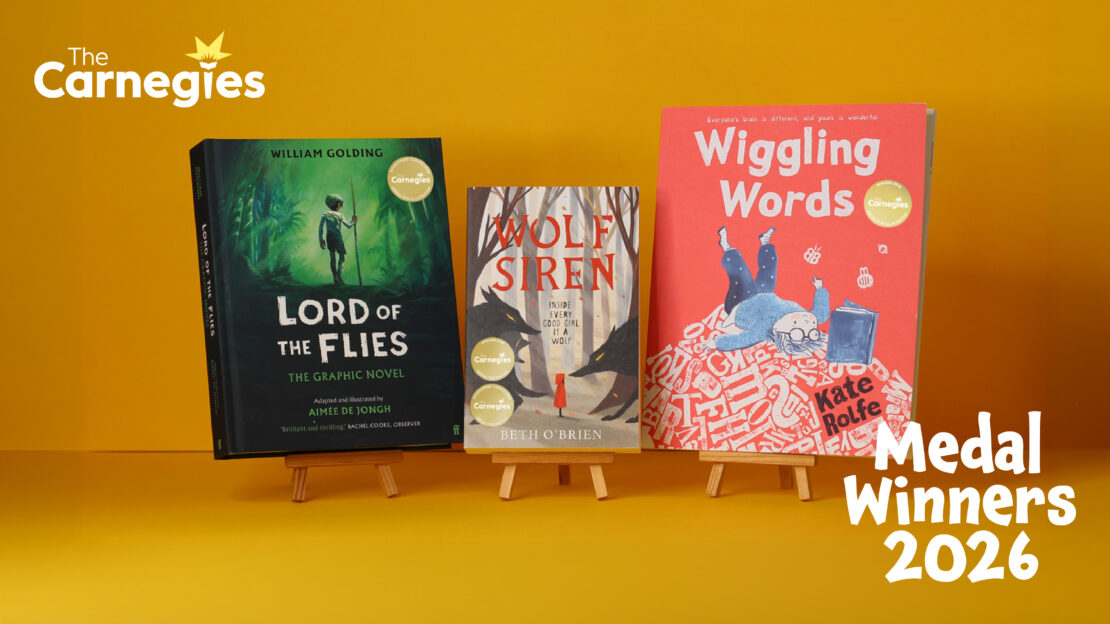
Tuesday 23 June 2026: The 2026 Carnegie Medal winners were announced today in front of an audience of over 600 young people during a live-streamed ceremony held at the Cambridge Theatre in the West End, home of the Royal Shakespeare Company’s multi award-winning Matilda The Musical, which is now celebrating 15 years. The awards are the UK’s longest running and best-loved book awards for children and young people, run by library and information association, CILIP.
The Carnegies celebrate achievement and outstanding reading experiences in books for children and young people. They are unique in being judged by an expert panel of children’s librarians, including 14 from CILIP: the library and information association’s Youth Libraries Group. Each year thousands of reading groups in schools and libraries across the UK and around the world also get involved in the awards, with young people ‘shadowing’ the judging process, debating and choosing their own winners from this year’s shortlist. Each year, the Carnegies work closely with the RNIB and Calibre Audio to make as many of the shortlisted books as possible available in alternative formats, so these celebrated stories are accessible to all readers; a commitment reflected in this year’s winners and during the National Year of Reading.
Stella Hine, Chair of Judges for The Carnegies 2026, said:
“Wolf Siren is a wonderful fairy tale for our times where hope triumphs over despair and justice over apathy. Red is a thoroughly traditional and yet modern heroine whose journey includes timeless messages for all, young and old. The environmental messages are clear, the language is sublime, and the rich content covering many contemporary themes invites reflection. Wiggling Words is a joyous and deceptively simple insight into the world of a dyslexic reader. Using typography and their signature cyanotype technique, Kate Rolfe not only affords the dyslexic reader a voice but also invites the non-dyslexic reader into this unique world. We accompany the young protagonist on their journey from frustration to empowerment. Many congratulations to the 2026 Award winners in this National Year of Reading. I’d like to thank the judging panel who sacrifice much of their personal time and energy for the Awards. Thank you to all the Shadowers around the country and overseas. Thank you to every teacher and librarian supporting young readers to explore these outstanding lists
Debut author Beth O’Brien wrote Wolf Siren, a captivating feminist reimagining of Red Riding Hood, from a desire to tell stories that spotlight the nuanced spectrum of sight inspired by her own lived experience of vision impairment. Blindness is often misrepresented as total sight loss, but in reality 93% of blind and partially sighted people experience a spectrum of light, movement, and colour. This authentic experience leads Beth to write lyrically, describing not what she sees but how she sees, inviting readers to uncover her world with all their senses. The Judges praised this “fresh” storytelling, and her “richly layered symbolism” to write a “strikingly relevant” reimagining exploring power, gender stereotypes and disability. Beth O’Brien is currently studying for a PhD researching the (mis)representation of disability in contemporary fairytale retellings, often primarily used as a plot device to be cured, a symbol of evil, or to be supplemented by a superhuman ability. Having grown up with an insatiable appetite for stories and writing, Beth O’Brien consumed books through the audio and large print editions at her local library. As an adult, she is now acutely aware that not everyone has access to these formats as easily, and advocates to make the magic of stories accessible to everyone.
Carnegie Medal for Writing winner, Beth O’ Brien, said:
“I am beyond stunned and delighted that Wolf Siren has won the Carnegie Medal for Writing. It is beyond the wildest hopes I ever had for this story! Wolf Siren speaks to so many things that I care about, from vision impairment representation and period stigma to the abuse of power and weaponised belief systems. And on a personal level it is about family, sisterhood, and friendship in the face of all this. It’s an honour to know this resonated with the judges and I am so grateful that this whole Carnegie journey has allowed Wolf Siren to find its way into the hands (or ears!) of young readers.”
Kate Rolfe was first shortlisted for the Medal for Illustration in 2025 for her debut book, Wolf and Bear, and has now won the award with her “deeply personal” picture book, Wiggling Words, which illustrates her experience with dyslexia. Dyslexia affects around 1 in 10 adults in the UK and 900,000 school children, and like many dyslexic people, Kate often tried to hide how her brain worked for fear of being judged. Wiggling Words is a celebration of her neurodiversity. The judges praised the “transformative journey from confusion to confidence” as readers gain insight into what reading can be like for someone with dyslexia; mountains of words and walls of letters. Importantly, it doesn’t end how you’d expect, with dyslexia something to ‘overcome’. Instead, Kate joyfully experiments with typography to visualise how she still struggles with language, whilst celebrating the way dyslexia helped her find creative solutions and fall in love with storytelling. She sees creativity as a doorway to reading to all, and at its heart, Wiggling Words is a book that celebrates the universal experience of learning to read, and finding your way through things that feel impossible.
Carnegie Medal for Illustration winner, Kate Rolfe, said: “I’m incredibly grateful to the Carnegie judges, librarians and shadowing groups for championing Wiggling Words. Receiving this award during the National Year of Reading feels so perfect! I absolutely LOVE books, but reading isn’t easy for me. Wiggling Words was inspired by my experience as a dyslexic reader, but it’s a book for every child learning to read. It celebrates creative problem-solving and playful ways into stories. The stories that captivate us when we’re young shape our values, shared humanity and the world we choose to build. We need diverse stories from every nation and background, disabled, neurodivergent, LGBTQ+ characters with experiences completely different from our own. In a world increasingly mired in fear, division and dehumanisation, diverse stories that build connection matter more than ever. If stories shape our future, accessibility and representation decides who has a voice in imagining that future – and we need it to include everyone
The winners of the Carnegie Medals for Writing and Illustration each received a specially commissioned medal and a £5,000 Colin Mears Award cash prize. The winners of the Shadowers’ Choice Medals – voted for and awarded by the children and young people – also received a medal and £500 worth of books to donate to a library of their choice, generously provided by the Centre for Literacy in Primary Education for the illustration winner and by CILIP for the writing winner.
– ENDS –
For further information on The Carnegies 2026 please visit: www.carnegies.co.uk
#Carnegies2026 | @CarnegieMedals on Instagram, X, Facebook, Threads, Bluesky & Tiktok
For media and interview requests, please contact:
Kirsten Cozens or Katie Cregg at ed public relations on Kirsten@edpr.co.uk or Katie@edpr.co.uk or 020 7732 4796.
For the winners’ speeches, images of the winning authors and illustrators, book jackets, illustrated spreads and social media assets, please click here. This Drive will be updated with further images from the winners’ ceremony in due course.
NOTES TO EDITORS:
Winning author and illustrator biographies and book synopses
Wolf Siren by Beth O’Brien (HarperCollins Children’s Books)
A vibrant, evocative and magical debut which centres a positive, empowered disabled character at the heart of a reimagining of Little Red Riding Hood. The woods are hiding a secret… but then so is Red… Red is not allowed to go into the woods. Everyone knows that they are dangerous – because of their strange magic and the wolves that lurk there… But Red finds herself increasingly drawn to the woods and the place where her grandmother disappeared without a trace three years ago. When the woodcutter fails to return home one night and wolves are spotted close to the village boundary, fear drives a deep and dangerous divide between the villagers and the nature they live alongside. Only Red seems to hold the key – but she has a secret, and exposing it could ruin her family forever.
Beth O’Brien is an English Literature BA and Creative Writing MA graduate from the University of Birmingham. She is also the author of four adult poetry books. Having been born visually impaired and with an upper-limb difference, Beth is passionate about the representation of disability in literature and is currently studying for a PhD researching the (mis)representation of disability in contemporary fairytale retellings. She is the founder and editor of Disabled Tales, a website dedicated to discussing disability in fairytales and folklore.
Wiggling Words by Kate Rolfe (Two Hoots)
Learning to read can be a struggle, and no one understands that better than the young child in Wiggling Words. Skip, trip, fumble and fall with them as they discover that even though words can be tricky, they can be fun too! Wiggling Words is for anyone who’s ever struggled with learning and felt alone in their struggle. The story is about finding your own way through things that feel impossible. In Wiggling Words the reader becomes the child on the page and we’re taken inside their world. The font is proven to help aid dyslexic readers and the cream background tones the contrast between the text and paper.
Kate Rolfe is an author and illustrator living in Suffolk who studied Animation at Plymouth College of Art, BA (Hons) Film Production at Northern Film School and graduated with an MA in Children’s Book Illustration at Cambridge School of Art in 2022. Aside from writing and illustrating her own ideas, she works in textile designs, teaches illustration, runs drawing sessions online and works in an independent bookshop. Kate has won many awards including New Talent in Children’s Publishing at the World Illustration Awards 2022 and Student Illustrator of the Year 2022 at the V&A Illustration Awards. Her first book, Wolf and Bear, also published by Two Hoots, was shortlisted for the Waterstones Children’s Book of the Year prize. Wiggling Words is the winner of the World Illustration Awards (children’s category) in 2024.
Lord of the Flies: The Graphic Novel illustrated & adapted by Aimée de Jongh, written by William Golding (Faber & Faber
A plane crashes on a desert island. The only survivors are a group of schoolboys. By day, they explore the dazzling beaches. By night, they are haunted by nightmares of a primitive beast and of what they’ve lost. Orphaned by society, they must forge their own; but it isn’t long before the group is split and their innocent games take a dangerous turn. ‘What are we? Humans? Or animals?’ For the first time, from acclaimed artist Aimée de Jongh, comes the stunning graphic novel adaptation of this classic story, one of the BBC’s ‘100 Novels that Shaped Our World’.
Aimée de Jongh (illustrator, adaptor) is a renowned graphic novelist. Her debut, The Return of the Honey Buzzard, won the Prix Saint-Michel and was adapted into a live-action film, while her graphic novel Days of Sand was an international bestseller and nominated for two Eisner awards. She has been published in eleven languages to date.
William Golding (author) (1911–1993) was born in Cornwall and educated in Marlborough and Oxford. Before becoming a writer, he was an actor, lecturer, small-boat sailor, musician and school teacher. In 1940, he joined the Royal Navy and later took part in the D-Day operation and the Allied invasion of the Netherlands. Lord of the Flies, his first novel, was rejected by several publishers but spotted by Faber and published in 1954. It became a modern classic, selling millions of copies and was translated into forty-four languages and made into a film by Peter Brook in 1963. Golding wrote eleven further novels, a play and two essay collections. He won the Booker Prize for Rites of Passage in 1980 and the Nobel Prize in Literature in 1983. He was knighted in 1988 and died in 1993.
The Carnegies
About CILIP, the library and information association
About Sora
About Scholastic
About ALCS
About First News
For media and interview requests, please contact:
Kirsten Cozens or Katie Cregg at ed public relations on Kirsten@edpr.co.uk or Katie@edpr.co.uk or 020 7732 4796.
For the winners’ speeches, images of the winning authors and illustrators, book jackets, illustrated spreads and social media assets, please click here. This Drive will be updated with further images from the winners’ ceremony in due course.