
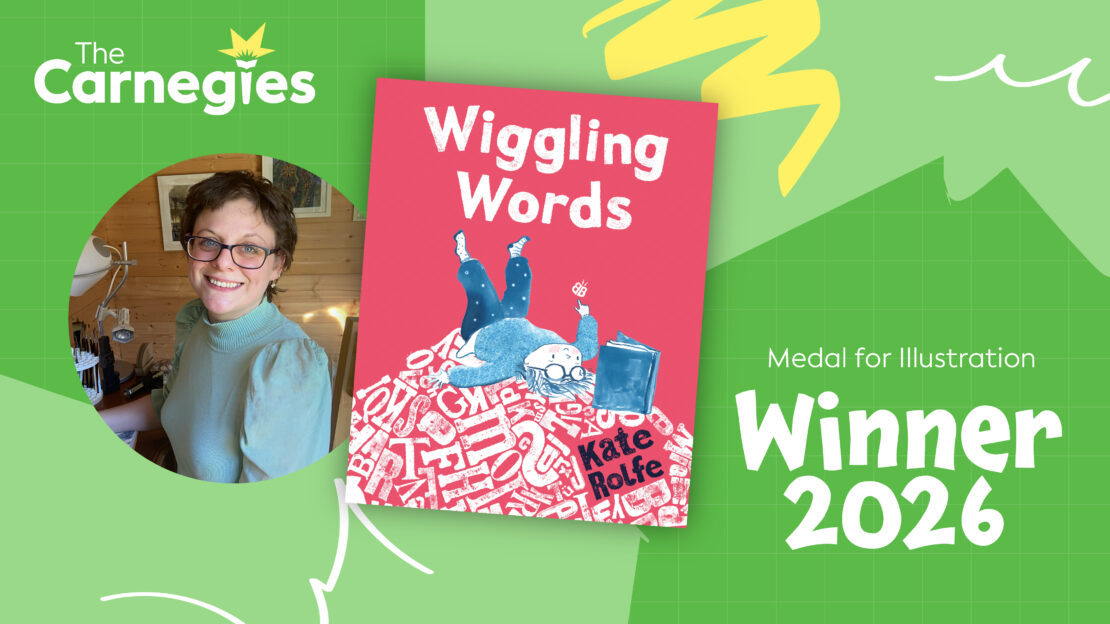
“WOW What a total honour! I’m completely pinching myself saying this.
Eternal thanks to Suzanne Carnell, Jo Spooner, Neil Dunnicliffe, Clare Hall-Craggs and Helen Weir; Two Hoots and Macmillan: such a supportive place to begin my career.
Huge thanks to my peers and tutors at Cambridge School of Art. My supportive friends – I’m privileged to cheer on your creative journeys. Julia Marsen-Dyer, the dynamic force behind Ottie and the Bea. Rob Ramsden, my partner and fellow author-illustrator whose energy and inspiration keeps my own alight.
To everyone making the beautiful books we’ve celebrated today – you’re shining authentic warmth in a world that too often feels cold right now, where discrimination and division grip our countries and communities.
Stories that capture our hearts when we’re young move the needle on our values. They inspire us to BUILD the world we want to see.
Each book on this shortlist shaped my perspective. When we step inside other people’s life experiences, we discover ourselves in there, decide our own opinions, then change how we show up in the world. Reading makes us cooler. Each book up-levels you, for life!
Librarians know this. Being a librarian in this divisive political climate is tough. I have so much respect for them, putting powerful, inclusive stories into children’s hands. It matters now more than ever. Huge thanks to every librarian who nominated, voted, and championed these books. Judges, shadowing groups, creative facilitators behind the Carnegie Awards.
And it’s the National Year of Reading! Especially perfect because Wiggling Words is about my complex relationship with reading. I love books. They’re my lifelong passion, but also a lifelong struggle.
Wiggling Words was inspired by my neurodivergent experience, but it’s a book for ALL children. Learning to read is something every child goes through – beginning to recognise letters, turning these strange marks on paper into meaning.
Here I’ve got to extend a huge thanks to Mum, and Dad, who nurtured a vibrant space where picture books were held in high esteem. I grew up knowing picture books aren’t something you ever grow out of.
And I never have. But reading is still quite inaccessible to me. I’ve had to be inventive about how I engage with books. I’ve come to realise there’s no single correct way to connect with a story.
Some discover stories through drawing, movement, performance, sensory experience, or play, long before text. If we only value one kind of participation – decoding letters and words – we exclude many children before they’ve had chance to fall in love with books.
School visits constantly remind me how contagious excitement around stories is. Making space for creativity, imagination and voice, means every child in the room feels stories belong to them. And that’s vital! But there’s something wrong there – I said every child in the room. And that’s the problem.
Often the children most needing imaginative, creative experiences are most likely to miss out. Schools who can’t host visits, children with unmet support needs, our growing population of home-learners, children already excluded from the room before the event began.
Let’s create more flexible, accessible ways to engage with stories and the experiences around them. Organisations, professional bodies, publishers, home-ed networks, individuals sharing this intention, please reach out.
Let’s work together to ensure that the future includes everyone.”